Sunday, December 9, 2018

American Public Spaces - The evolution of the US Capitol gardens & grounds

Cherry Blossoms at the United States Capitol Building

Each spring, America's National Cherry Blossom Festival commemorates the 1912 gift of 3,000 cherry trees from Mayor Yukio Ozaki of Tokyo to the city of Washington, DC. In a simple ceremony on March 27, 1912, First Lady Helen Herron Taft & Viscountess Chinda, wife of the Japanese ambassador, planted the first 2 trees from Japan on the north bank of the Tidal Basin. In 1915, the United States Government reciprocated with a gift of flowering dogwood trees to the people of Japan.


Cherry Blossoms in Washington DC

Only a little over 100 years before the first Cherry Blossoms arrived in Washington DC from Japan, on May 3, 1802, Washington DC was incorporated as a city. In 1789, the US Congress - Senate & House of Representatives - assembled for the 1st time in New York. Congress moved to Philadelphia in 1790, and then to Washington, DC, in 1800. In 1807, the Congress moved into the U.S. Capitol in Washington, DC, 4 years before the Capitol’s House wing was fully completed. In 1814, the nation was severely tested, when invading British forces burned the Capitol. It would be another 5 years before the chambers were fully restored. In 1857, the House met for the first time in its present-day chambers. This posting will look at the development & the symbolism of the building & the gardens around the United States Capitol.


Classical Temple Dedicated to Liberty, Justice, and Peace. James Trenchard. Temple of Liberty. The Columbian Magazine, (Philadelphia) 1788, Library of Congress.  This engraving of a classical temple building depicts statues on the roof, including Libertas (liberty), Justicia or Themis (justice), & Ceres (peace). Libertas is at the peak with the others on the corners. In the background a rising sun radiating beams of light with one shining upon Libertas holding her staff & freedom cap. Emerging from the pure, bright sunlight in the distance is the new nation--lady Columbia with an eagle headdress. Standing below is Concordia holding a horn of plenty; Columbia's winged son holding a scroll with CONSTITUTION written on it; and Clio, the muse of history, beginning to write the history of the new nation. Scrolling across the front of the classical temple are the words: SACRED TO LIBERTY, JUSTICE AND PEACE. Below this engraving was written,

Behold a Fabric now to Freedom rear'd,
Approved by friends, and ev'n Foes rever'd,
Where Justice, too, and Peace, by us ador'd,
Shall heal each Wrong, and keep ensheath'd the Sword
Approach then, Concord, fair Columbia's Son,
And faithful Clio, write that "We Are One."
In 1788, Philadelphia's Columbian Magazine published an engraving by James Trenchard called the Temple of Liberty. Trenchard, born in 1746, at Penns Neck in Salem County, New Jersey, was an engraver & seal cutter in Philadelphia, and the artist for many of the plates for the Columbian Magazine, whose circulation was the largest of any 18th century magazine published in America.


Dr. William Thornton [Sketch of Section of Monument and Conference Room], c. 1797 Prints and Photographs Division Library of Congress. Thornton's drawings and concept won the contest to design the capitol.

Built on what came to be called Capitol Hill, its grounds changed greatly over the first half of the 19th century. I thought you might enjoy seeing the various depictions of the changing landscape.

Dr. William Thornton [East Elevation for North Wing], 1795-1797 Prints and Photographs Division Library of Congress.

Fierce competition over the site of the capital city had raged for years, reaching its height during the First Federal Congress, in New York between 1789 - 1790.

Dr. William Thornton [Plan of Ground Story of the Capitol,] c. 1795-1797 Prints and Photographs Division Library of Congress.

The always clever Alexander Hamilton helped broker a compromise in which the federal government would assume the war debt incurred during the Revolution, in exchange for support from northern states for locating the capital further south than New York or Philadelphia.

Dr. William Thornton's winning plan for the Capitol of the United States of America.

The compromise between the advocates for the North and those favoring a Southern location ended the feuding by agreeing on a nearly neutral location on the Potomac River, equidistant between North & South, and easily defended. (It had been George Washington's choice all along, and it was Hamilton's goal to please the General.)

c 1800 A View of the Capitol of Washington Watercolor by William Birch.

The agreement called for a 100-square mile federal district to be located somewhere along the Potomac River at a site to be chosen by fellow river-property owner, George Washington. Washington picked the junction of the Potomac & Anacostia Rivers. He then chose Pierre Charles L'Enfant, a military artist who had served under him at Valley Forge, to design the new federal city.

An 1801 View of George Town and the Federal City, or the City of Washington before its development into the federal city. Color aquatint by T. Cartwright of London after George Beck of Philadelphia. Published by Atkins & Nightingale of London and Philadelphia.

The Capitol of the United States crowns what was then Jenkins Hill in Washington, D.C., and houses the legislative branch of government, the House of Representatives & the Senate.

1806 Benjamin Latrobe View of the Capitol of the United States.

Pierre Charles L'Enfant chose Jenkins Hill as the site for the United States Capitol building, which rose 88 feet above the Potomac River, and sat 1 mile from the White House. L'Enfant declared, "It stands as a pedestal waiting for a monument."

A view of the still undeveloped East Branch of Potomac River at Washington. Watercolor by August Kollner (1813-1906) in 1839.

The land on which the Capitol stands was 1st occupied by the Manahoacs & the Monacans, who were subtribes of the Algonquin Indians. Early settlers reported that these tribes occasionally held councils not far from the foot of the hill. This land eventually became a part of Cerne Abbey Manor. At the time of its acquisition by the federal government "Jenkins Hill" was owned by the well-to-do Marylander Daniel Carroll of Duddington, and it stood on a tract of land originally known by the more classically-inspired name of "New Troy."

1814 George Munger (1781-1825). United States Capitol after the British burned the capitol.

Thomas Jefferson came up with the name Capitol Hill, consciously invoking the famous temple of Jupiter Optimus Maximus on the Capitoline Hill in ancient Rome. The building would be America's Temple of Liberty.

Depiction of the United States Capitol before the fire of 1814.

George Washinton & his allies wanted buildings that would embody the nation's hoped-for future. "In our Idea the Capitol ought in point of prosperity to be on a grand Scale, and that a Republic especially ought not to be sparing of expenses on an Edifice for such purposes."

1815 1st known depiction of the Capitol in Relation to Its Grounds by Benjamin Henry Latrobe [Plan of the Mall and the Capitol Grounds], Geography and Map Division Library of Congress.

The 1792 competition for its design was won by Dr. William Thornton (1759–1828), a physcian & an amateur architect, with a proposal for a Palladian-inspired building featuring a central domed rotunda flanked by the Senate & House wings.


1824 Charles Burton's West Front of the Capitol of the United States. This view of the Capitol was a gift to the Marquis de Lafayette to commemorate his speech delivered in to the House in 1824. Here workmen are constructing the earthen terraces along the western front, while in the foreground are the growing Lombardy poplars planted during Thomas Jefferson’s administration.

President George Washington, dressed in masonic attire, laid the cornerstone in 1793, in a masonic ceremony. At this time the site of the Capitol was a relative wilderness partly overgrown with scrub oak. Oliver Wolcott, a signer of the Declaration of Independence, described the soil as "an exceedingly stiff clay, becoming dust in dry and mortar in rainy weather." A muddy creek with swampy borders flowed at the base of the hill, and an alder swamp bordered by tall woods occupied the place where the United States Botanic Garden now stands. The city's inhabitants, like L'Enfant & Washington, expected that the capital would grow to the east, leaving the Capitol & the White House essentially on its outskirts. For some years the land around the Capitol was regarded as a common, crossed by roads in several directions & intended to be left as an open area.

1828 Contrast Between the Temple of Liberty and Nearby Log Cabins by John Rubens Smith. [West Front of the Capitol]. Prints and Photographs Division Library of Congress.

Construction proceeded slowly under a succession of architects, including Stephen Hallet (1793), George Hadfield (1795-98) and James Hoban (1798-1802), architect of the White House, who completed the Senate wing in 1800.

1830-40 Early Perspective Drawing of Completed Capitol Attributed to George Strickland [Perspective drawing of the Capitol from the Northeast,] In the Collection of the Architect of the Capitol.

Though the building was incomplete, the Capitol held its first session of United States Congress on November 17, 1800.

Das Capitol in Washington" Steel engraving by E. Grünenwald after an earlier drawing by H. Brown. Published in 1851.

Benjamin Latrobe took over in 1803; by 1811 he had renovated the Senate wing and completed the House wing.

1839 Capitol Overlooks Pastoral Landscape by Russell Smith. Capitol from Mr. Elliot's Garden. In the Collection of the Architect of the Capitol.

Benjamin Latrobe first considered the Capitol building in relation to its grounds and made a watercolor of the possible landscape design in 1815.

1839 Charles Fenderich's Elevation of the Eastern Front of the Capitol of the United States.


The Senate wing was completed in 1800, while the House wing was completed in 1811. However, the House of Representatives moved into the House wing in 1807.

August Kollner (1813-1906). West Front of the United States Capitol. New York: Goupil, Vibert, & Co., 1839. Library of Congress.

The Capitol was burned by British troops in 1814; and in the following year, Latrobe began its reconstruction and redesign.

1840 W.H. Bartlett's Ascent to the Capitol in Nathaniel P. Willis, American Scenery, vol. 1. London Virtue.

Boston architect Charles Bullfinch succeeded him in 1818; and completed the building, with only slight modifications of Latrobe's master plan, in 1830. Under Bullfinch in 1825, a plan was devised for imposing order on the Capitol grounds, & it was carried out for almost 15 years. The plan divided the area into flat, rectangular grassy areas bordered by trees, flower beds, & gravel walks. The growth of the trees, however, soon deprived the other plantings of nourishment, & the design became increasingly difficult to maintain in light of sporadic & small appropriations.

John Foy, who had charge of the grounds during most of this period, was "superseded for political reasons," & the area was then maintained with little care or forethought. John Foy was dead by 1837, and James Maher took over as the public gardener.  Many rapidly growing but short-lived trees were introduced and soon depleted the soil; a lack of proper pruning and thinning left the majority of the area's vegetation ill-grown, feeble, or dead. strong>

1840 W.H. Bartlett's View of the Capitol at Washington in Nathaniel P. Willis, American Scenery, vol. 1. London Virtue.

By 1837, the Washington Guide reported, The Capitol Square has been enlarged to the west, by taking in that part of the Mall extending from the circular road to First street, west; making about eight acres additional. This space has been properly graded and planted with trees and shrubs by Mr. James Maher, the public gardener:—the other part of the square was planted by the late John Foy, a man of excellent talents and taste. A good substantial stone wall, surmounted by an iron-railing, surrounds the whole square. When the walks are completed, and the water-fountains arranged, this square will afford the most beautiful and healthful walks: a subject well deserving public attention.

1839 South Gateway of the Capitol at Washington, D.C. showing stone walls & iron rails. Gray and sepia wash drawing by August Kollner (1813-1906).

Daguerreotype by John C. Plumbe, Jr., taken about 1846, is the earliest known photographic image of the Capitol. Library of Congress.

In 1874, Congress passed an act making Frederick Law Olmsted (1822-1903) the first landscape architect of the United States Capitol. Olmsted accepted the job, wishing to "train the tastes of the nation." The mid-19th-century enlargement of the US Capitol, in which the House & Senate wings & the new dome were added, required that the Capitol grounds be expanded.


John Singer Sargent (American artist, 1856-1925) Frederick Law Olmsted 1895

Olmsted's original concept for the design for the governmental buildings clustered in Washington, DC envisioned a ground plan that united the White House, Capitol &, other government agencies to symbolize the union of the nation, which was still trying to overcome the divisions of the Civil War. In his previous landscape design plans, Olmsted had made architecture less important than its green surroundings. However, for the seat of the legislative branch of the United States of America, Olmsted wanted to make the Capitol building the crowning centerpiece. Olmsted was determined that the grounds should complement the building.

Reflecting on his work, Olmsted recalled: "The most interesting general fact of my life seems to me to be that it was not as a gardener, a florist, a botanist, or one in any way specially interested in plants & flowers, or specially susceptible to their beauty, that I was drawn to my work. The root of all my work has been an early respect for & enjoyment of scenery, & extraordinary opportunities for cultivating susceptibility to its power. I mean not so much grand or sensational scenery as scenery of a more domestic order -- scenery which is to be looked upon contemplatively & is producing of musing moods."

His 15-year-long project on the grounds of the United States Capitol did envision an open setting immediately surrounding the Capitol & a more naturalistic scenery with shrubbery & trees further from the Capitol, nearer to its entrances.  Because of the many streets & entrances merging at the capitol, the creation of a workable circulation system dominated the design process. The east side of the Capitol needed more open spaces for large masses of people gathered for inaugurations & other large events normally held at the East Front. Two large ovals with scattered trees were designed for the east side to accommodate the grounds needed during such events.


Olmsted's 1874 Plan for the US Capitol

Before he could begin to execute his landscape design, the practical Olmsted had to ensure the soil's nutrients. He began by spending $60,000 to improve the soil; level the ground; & add new sewer, gas & water systems.  Work on the grounds began in 1874. Olmsted constructed marble terraces on the north, west, & south sides of the building, thereby "causing it to gain greatly in the supreme qualities of stability, endurance, & repose."

By 1876, gas & water service was completed for the entire grounds, & electrical lamp-lighting was installed. Utilitarian areas such as stables & workshops were removed from the northwest & southwest corners. A streetcar system, quickly replacing the horses from those displaced stables, north & south of the west grounds was relocated farther from the Capitol. The granite & bronze lamp piers & ornamental bronze lamps for the east plaza area were completed  & installed.  Work on the plantings accelerated in 1877.  By this time, according to Olmsted's report, "altogether 7,837 plants & trees [had] been set out." However, not all had survived: hundreds were stolen or destroyed by vandals, &, as Olmsted explained, "a large number of cattle [had] been caught trespassing." Washington DC had not yet lost all of its rural charm.

By 1879, the roads were paved & most of the work on the east side of the grounds was completed. The stone walls on the west side of the grounds were almost finished.  In 1885, an aging Olmsted retired from superintendency of the huge terrace project; but he continued to direct the work on landscaping the grounds until 1889. In 1895, senility forced Olmsted to retire from his lifetime of work.

Arieal view of the United States Capitol. The Capitol Grounds cover approximately 274 acres.

Information on Olmstead from Architect of the Capitol & from Christine Owen US Capitol Historical Society. 

Friday, December 7, 2018

Philadelphia's 19C Public Pleasure Gardens

Guest Blog - 

"Pleasure Gardens, Without Worry, In The City"
Harry Kyriakodis

“There is nothing more conducive to the health of a populous city, than free circulation of air, and in this respect Philadelphia is pre-eminently fortunate.” These words appear in Philadelphia in 1830: or, A Brief Account of the Various Institutions and Public Objects in This Metropolis.


William Penn 1644-1718

The Philadelphia guide book briefly describes the 5 public commons that William Penn incorporated into his plan for his “Greene County Towne” -- namely, Penn (formerly Centre) Square, Washington (South East) Square, Franklin (North East) Square, Rittenhouse (South West) Square, and Logan (North West) Square. 


William Penn's Greene County Towne Plan for Philadelphia

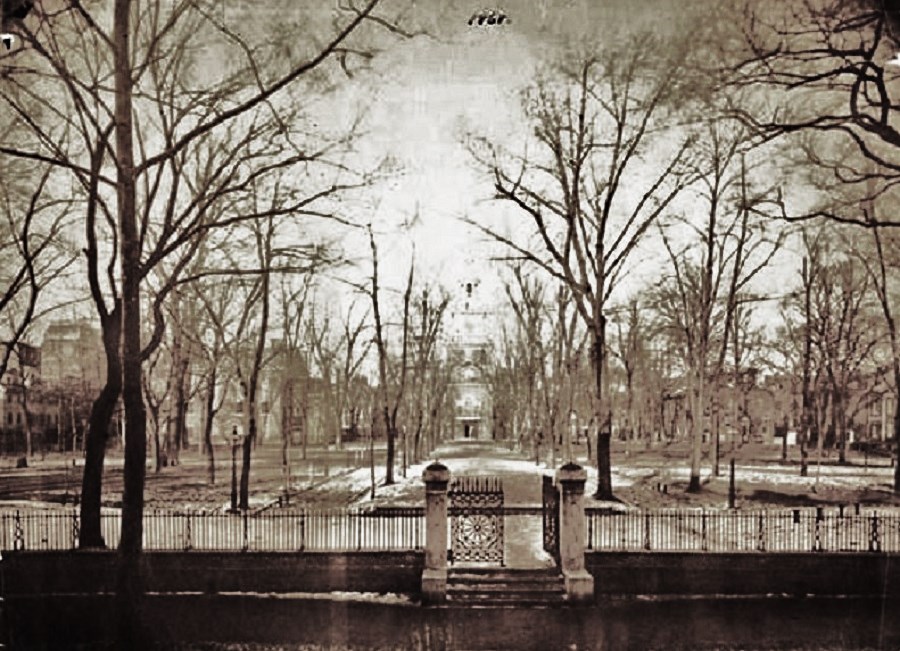
The 1830 Philadelphia guide book also characterizes Independence Square as “enclosed by a substantial iron railing, and planted with trees; the walks are tastefully laid out and gravelled—it is thrown open to the public, and as a promenade, is a place of general resort.”


1868 View of Independence Square

Philadelphia in 1830 was issued long before Philadelphia’s Fairmount Park had been conceived. And the Philadelphia Zoo would not open until 1874.  Even the individual park spaces that today make up a good bit of Fairmount Park are not described, as they had not been established as public spaces by 1830.  In that era, Philadelphia was only 2 miles wide between South and Vine Streets and the settled portion extended westward to about Broad Street.

The 1830 booklet, however, does describe 3 privately-owned pleasure gardens west of Broad Street that could be enjoyed as “general resorts”—for a fee: McArran’s Garden; Smith’s Labyrinth Garden; and Sans Souci Garden. These were the big botanical resorts located in what is today the western part of Center City. They offered Philadelphians of the early 19C a carefree and manicured respite, all pretty much in what was then the middle of no place.  Before the city’s industrialization made Fairmount Park a necessity for personal health and to relieve the city of its harshness, these places were where regular folks, for a price, could spend some time in elegant outdoor surroundings.

Not only was the unsettled area west of Broad Street the location of such commercial pleasure gardens, but this zone was also where many orphan asylums, hospitals, insane asylums, almshouses and prisons were relegated. In other words, west of Broad was way out of town and thus out of the sight and mind of decent folks who lived, even in the 1830s, within just ten or twelve blocks from the Delaware River. You only dared west of Broad, if you were passing through to locales farther west or if you had some unfortunate inmate to visit in one of those gloomy asylums.

Certainly, for a day of rest and recreation outside, Philadelphia’s growing urban population could head to one of William Penn’s city parks. But these were often undeveloped and not as decorous as they are today. Logan Square, for example, was used as a potter’s field and a setting for public hangings until 1825. A rural cemetery, such as Laurel Hill or any of the other out-of-town cemeteries, could surely provide Philadelphians with an environment that was peaceful (in more ways than one), but these burial grounds were often too far from the core of the city.

The better recourse would be to simply make your way past Broad Street for a day at one of the botanical gardens in that part of town. These amusement resorts—which served as the Philadelphia Zoo or Great Adventure of the day—were quasi-public places, some drawing attention to exotic species or particular styles of gardening, while others offered meals and forms of entertainment, such as music, fireworks, and balloon ascensions. Their greenhouses often were stocked with exotics and the grounds were neatly laid out with flowers and fruit trees according to the English way of setting up formal gardens. Many were named after similar places in England and elsewhere. The proprietors knew how to lure people to their resorts.


McArans Pleasure Garden.  This drawing of “McAran’s Pleasure Garden” is by Frank H. Taylor, after a painting by David J. Kennedy. 

McArran’s (or M’Aran’s) Garden (1839-1842) was located between 17th and 18th Streets alongside Filbert Street (now JFK Boulevard). The 4 acre retreat, more or less on the present site of the Comcast Center and the Arch Street Presbyterian Church, was handsomely laid out and offered a great variety of rare plants. The proprietor, John McArran, had collected and covered his premises with shade trees, greenhouses, and so on. The place was also known for its fine collection of birds; a bald eagle once lived on site.

A botanical gardener and purveyor of seeds as early as 1821, McArran had decorated the grounds of Lemon Hill for Henry Pratt. He specialized in giving his patrons strawberries and cream in the season. John McArran was also a land speculator in regard to his resort property, keen on ultimately making a profit from its sale. 

Signor Antonio Blitz, an accomplished 19C magician, performed at McArran’s Garden and later wrote:  "I remember [McArran] taking me to look at a field of some acres planted with the trees, and his remarking that he had refused an offer of fifteen thousand dollars for them. I inquired what he expected to receive? He replied “Double that amount!” But his hopes failed for in a few days following, the bubble exploded and he not only lost all he had invested, but seriously involved himself."

Another nearby resort was Smith’s Labyrinth Garden, once between Cherry and Arch Streets and 15th and 16th Streets. The original garden was established by one Daniel Engelman, a florist and nurseryman from Holland, who came to Philadelphia in 1759. Englishman Thomas Smith subsequently acquired the tract and turned it into a place of amusement. Smith was known around Philadelphia for his accurate meteorological observations and record keeping.

The compilers of Philadelphia in 1830 describe Smith’s Labyrinth Garden as displaying “ingenuity,” meaning that this was indeed an irregular network of passageways that guests could plod their way through. They could even do this at night, for the resort was “usually illuminated nights, and the visitors are entertained with instrumental music.”

In 1830, a curious feat was accomplished at the Labyrinth Garden. A man undertook a walk around the grounds as part of a $1000 bet that he could walk a thousand miles in eighteen days. The task was commenced by one Joshua Newsam on September 30th. The 27-year old fellow walked along a course within the Labyrinth while crowds came to see him, evidently paying for admittance and spending some time at the garden. (Thomas Smith encouraged this challenge because he had witnessed such feats earlier in his life and wanted to revive one of the manly exercises of England.) Starting at 6 am each day, Newsam walked in all weather and pushed out about sixty miles a day. Attributing a leg sprain to all the turns he had to make to stay on the course, Newsam nevertheless completed the exercise in 18 days, having walked a thousand miles and never leaving Philadelphia. He did, however, lose 15 pounds.


The city block-large Sans Souci Garden appears above and to left of Logan Square in this ca. 1837 Map of the City of Philadelphia drawn by J. Simons. 

Sans Souci Garden was the largest for-profit botanical haven within the current-day confines of Center City. It boasted a fine hotel at which visitors were furnished with fruit from the garden greenhouses as part of their refreshments. Sans Souci (French: without worry) had been established in 1808, and remained in operation through the 1830s. The garden was respected for its botanical collection; a portion of William Hamilton’s private collection—developed at the Woodlands in West Philadelphia—wound up there.

Sans Souci occupied the entire city block between Arch and Race Streets and between 20th and 21st Streets, now the site of Center City housing and Saint Clement’s Episcopal Church. The resort was also immediately south of the Magdalene Asylum (a private charitable organization for the redemption of prostitutes) and the Pennsylvania Asylum for the Blind—illustrating how such institutions were established outside of the populated sectors of the city. 

These 3 tranquil public pleasure gardens were gone by the mid-1800s, as the city grew. The land they occupied in the heart of town became much more valuable by then; housing was generally erected on these practically undefiled properties. Furthermore, the resorts gradually lost their appeal as other types of amusements came to the fore.


Alfred M. Hoffy, lithographer. View of Robert Buist’s City Nursery & Greenhouses. Philadelphia Wagner & McGuigan, 1846.

For-profit botanical seed and nursery gardens also had been established in the surrounding districts of Northern Liberties, Southwark, and Moyamensing in the early 19C too. Buist’s Garden was on Lombard Street, near Tenth, and was run by nurseryman Robert Buist. He began the first commercial propagation and sale of poinsettias. Parker’s Garden was on Prime Street (Washington Avenue) beside Tenth Street had was handsomely laid out with arbors, gravel walks and so on.

The 18C Landreth’s Garden which sold plants and seeds was on Federal Street near the Schuylkill, founded by David Landreth, who in the late 1700s established D. Landreth & Company.  His son opened a seed store near Third and Chestnut Streets that sold plants and also started publication of the Floral Magazine and Botanical Repository.

The 18C Gray’s Gardens, a public pleasure garden which had its heyday from 1789-1792, at the Lower Ferry over Schuylkill River, was one of the earliest such retreats in the region. All traffic to and from the South passed by this place since it was run by the family that held the ferry concession (and, later, floating bridge) at the spot. On top of being an objective for pleasure trips from town, Gray’s Gardens became a favorite place to welcome guests to Philadelphia. Citizen committees would meet important people there and accompany them to the city. George Washington repeatedly received civilities at what may be called the old gateway into Philadelphia.


This extract from the 1858-1860 Philadelphia Atlas by Hexamer & Locher shows the orderly grounds of the remaining part of Vauxhall Garden at the northeast corner of Broad and Walnut Streets. The Garden originally took up the entire city block (to Juniper Street). Right at the intersection is the Dundas-Lippincott Mansion (the “Yellow Mansion”). 

Remarkably, the 18C Bartram’s Garden, where plants & seeds were sold worldwide, remains on the west bank of the Schuylkill to this day. In fact, Bartram’s once advertised that “railroad cars to Wilmington pass through the grounds and afford the means of reaching this delightful spot.”


 Bartram's Garden in 2012 from bartramsgarden.org

Returning to what was to become Center City Philadelphia, there were several other cultivated open-air areas. The Lebanon Garden, notorious for its popular tavern, opened in 1815 at Tenth and South Streets and exhibited fireworks for years on the Fourth of July. On Fourths of July fireworks were generally displayed. A sign hung in front of the garden with verses on the sign. On the east side was inscribed;
"Neptune and his triumphant host 
 Commands the ocean to be silent, 
  Smoothes the surface of its waters, 
 And universal calm succeeds." 

On the opposite, or west side, was the following:
"Now calm at sea, and peace on land, 
   Has blest our continental shores; 
 Our fleets are ready at command 
   To sway and curb contending powers." 

Over the old Lebanon Garden Tavern were these lines:
"Of the waters of Lebanon
  Good cheer, good chocolate and tea, 
With kind entertainment 
  By John Kenneday." 

The inauguration of General Andrew Jackson as President was celebrated at the Lebanon Garden in 1829, "by an old-fashioned bear-roasting & the destruction of other eatables...The old Lebanon at that time was kept by the late Captain John Pascal, & the day passed off without anything to mar the pleasure of the occasion...A buffalo's tongue was prepared & smoked & sent to General Jackson by Captain Pascal. A buffalo was bought by him from a well-known butcher at that time named Charles Pray. It came from the West with a drove of cattle, & 70 dollars were paid for it. It was penned up at Old Lebanon, & fed on hay & a bushel of potatoes daily. On the day before the barbecue several hundred persons congregated to see the fun. A stout rope, about 150 feet long, was made fast in the middle to the horns of the beast, & about 50 persons took hold of each end & drew him back in the garden, which extended to Shippen street from South street. A ring had been made secure to the centre tree of 3 old cherry trees, in a row running east & west. The end of the rope was passed in & gradually drawn through the ring by the persons alternately letting go as they got to the ring, & exchanging their hold to the end which had passed through it. Both ends were finally made fast to the next trees. A Mr. Peal, who had frequently shot buffaloes on the prairies, stood 20 yards off & shot several times at the animal, aiming to strike him behind the fore shoulder. At each shot the buffalo merely gave a shudder. This Mr. Peal thought strange, & then he shot him in the head, which he did not wish to do for fear of destroying his skin, desiring it as perfect as possible, to have it prepared for Peale's Museum, where, indeed it finally was placed, & a bunch of candles hung at the side made of the fat of the said beast . After having been shot in the head the animal fell on his knees & rose several times. Fearing the possibility of his breaking loose, he was knocked in the head with a butcher's axe & killed. On the northerly tree the heart was hung up, exhibiting the holes made by the bullets, each one having passed through it. The tongue was prepared & smoked, & packed in a polished hickory box, in hickory shavings made for the occasion, resembling curled ribbons, by Henry J. Bockius, carpenter, & was sent to General Jackson. A bear was also killed, & roasted whole on a windlass such as was also built for the buffalo. Fires were kept up with pine & hickory wood all the night before."

Three blocks up on South Street, at Thirteenth Street, was Hibbert’s Garden, with its superb collection of dahlias and japonicas.

The Tivoli Garden, on the north side of Market Street between Thirteenth and Centre Square, first opened in 1813 as the Columbian Garden. Besides the other pleasure garden enticements, it offered a “summer theatre” for pantomimes and light acting, such that it eventually became a theatrical center of some importance. And from 1800 to 1818, Fouquett’s Garden, between Tenth and Eleventh and Arch and Race Streets, sold guests mead and ice cream.

The Lombardy Garden opened about 1800 on the west side of Centre Square, at Fifteenth and Market Streets.  The garden derived its name from a group of Lombardy poplars planted around there by William Hamilton, when Centre Square was the location of the city’s first waterworks. The proprietor, one James Garner, provided breakfast and turtle soup for his patrons. Concerts, fireworks shows and circus-like exhibitions were held there amid the poplars and the serpentine gravel pathways. The Lombardy Garden apparently lasted until 1830, when it was reopened as Evans Garden. 

For six additional years, the First City Troop used the Evans Garden for its drills and their place of assembling. In the summer of 1828, they went on an encamping excursion to Yellow Springs, Chester County.  They invited Frank Johnson, the celebrated African American musician, to perform on his bugle, while the Troop were preparing to depart...On that excursion the Troop assembled in the garden with over 80 equipped men, plus a few other "invited" gentlemen. Singers at the Chestnut Street Theatre were heard at Evans Garden on summer evenings. The property was sold for residential development in 1836.


The Pagoda and Labyrinth Garden, Philadelphia. Lithograph by B. Ridgeway Evans. 

One of the last gardens opened was the Chinese Pagoda and Labyrinth Garden in 1828, on the rising ground northeast of where the Philadelphia Art Museum is today. The buildings were designed by John Haviland and the pagoda was 100 feet high, providing a splendid view of the Schuylkill River. Unfortunately, the roads to this resort from town were usually in bad condition, so the enterprise was not a success.

Vauxhall Garden was perhaps the most celebrated pleasure ground in Philadelphia. The place went into operation in about 1814 on the city block between Walnut and Sansom and between Broad and Juniper Streets. The ground had been originally been owned by Colonel John Dunlap (of Revolutionary War fame) and David Claypoole (of the publishing firm of Dunlap & Claypoole). It was Dunlap who embellished the place with choice trees, flowers, and graveled walks.

Named after London’s famed pleasure garden, Vauxhall (1813-1819-1838) also had a dancing-room large enough for balls, which must have helped make it the most fashionable of all Philadelphia’s pleasure gardens. Indeed, Vauxhall was touted as the most beautiful summer resort in the United States and visitors described it as “a little paradise.” Admission on days offering music was 50 cents, with 25 cents returned in the form of refreshments. Illuminated with “variegated lamps” at night, the venue featured fireworks, hot air balloon ascensions, and parachute leaps from those balloons...

On the evening of September 8, 1819, Vauxhall Garden was destroyed by a mob that took offense at a postponement in the presentation of a balloon ascension. (The balloon itself was ripped to shreds.)...One observer recounted, "one of the high constables of the city, rushed into the room and informed Mr. Wharton that a terrible riot and fire were in progress at the Vauxhall, caused by the failure of a balloon ascension. The company at once left for the garden. On approaching Thirteenth street the (old) elm tree was discovered on fire. They all hurried into the enclosure. Several arrests were made of the rioters, and the disturbance was quelled, but not until much damage was done." 

The place reopened as the Vauxhall Theater and persisted as a summer stage and open space for a number of years. The Marquis de Lafayette was feted there with a grand banquet in 1825. The elderly general was received at the entrance by one hundred little girls all dressed in white.

The theater was demolished in 1838, and Scottish millionaire James Dundas built the famed “Yellow Mansion” at the intersection of Broad and Walnut. Designed by Thomas Ustick Walter, the great house was the scene of many of social events in Philadelphia. The mansion’s charming garden along the east side of Broad Street was actually part of the old Vauxhall Garden. President McKinley reviewed the troops from a grandstand in the garden during the 1898 Peace Jubilee celebrating the end of the Spanish American War.


Frank H Taylor The-Yellow-Mansion a.k.a. the Dundas-Lippincott Mansion, showing some of the remaining Vauxhall property. This early 20C print was drawn by Frank H. Taylor. Detail

It’s too bad that all of these money-making resorts are long gone. Then again, Bartram’s Garden is still around and can today give us the very same pleasure that the botanical gardens of the early 19C gave Philadelphians back then. Still, we sure could really use a nice garden in Center City, maybe with an ingenious labyrinth and leaps from hot air balloons.

About the guest author:
Harry Kyriakodis, author of Philadelphia's Lost Waterfront Northern Liberties and The Story of a Philadelphia River Ward, regularly gives walking tours and presentations on unique yet unappreciated parts of the city. A founding/certified member of the Association of Philadelphia Tour Guides, he is a graduate of La Salle University and Temple University School of Law, and was once an officer in the U.S. Army Field Artillery. He has collected what is likely the largest private collection of books about the City of Brotherly Love: over 2700 titles new and old.

Wednesday, December 5, 2018

American Public Spaces - Boston Common

Boston Common

When the Puritans arrived in Boston in 1630, they met William Blaxton, an Anglican clergyman who had already settled on the western slope of Beacon Hill 5 years earlier, with 200 books to read & a few cows to feed, which he conveniently allowed to graze on what is now Boston Common.

After meeting the very serious & determined Puritans, the perceptive cleric decided to cart his books & his cows to quieter Rhode Island. In return for 30 pounds sterling, he sold them about 44 acres of his land. The practical Puritans also needed a common pasture to feed their livestock, as well as a place to gather.  In 1660, it was decreed, "Hereafter there shall be no land granted either for house plot or garden to any person, out of the open ground or common field."
Boston 1768 Sidney L. Smith after Christian Remick A Prospective View of Part of the Commons 1902 after a drawing from 1768

On the grand eminence of the Commons, the Puritans & their descendants & new immigrants did graze their livestock; built public buildings & graveyards; & executed a variety of heretics, dogs, witches, Quakers, felons, & other non-conforming souls. These gruesome events provided an intriguing excuse for public gatherings attended by large, curious crowds. The common was the community meeting grounds, where social & entertainment events of all sorts took place.  In 1674, John Josselyn commented, "On the South there is a small but pleasant common, where the Gallants a little before Sunset, walk with their Marmalet Madams."

The Boston Common also served as the military "trayning field" for Massachusettes colonial militias who protected the locals but ultimately served the English king. As unrest with British rule grew, regular troops, most born & trained in England, arrived in 1768, to occupy the city; and they set up their military camps across the people's Commons. On April 18, 1775, when 700 Redcoats assembled on the Boston Common to organize a march to Concord to seize a cache of weapons hidden by the Patriots, the Boston Massacre shortly ensued. The fight was on.
Boston Common, James Kidder, 1829

When the British finally sailed home; the long Revolutionary War concluded, the people got their common back. Boston Common evolved into a public space used for personal recreation, patriotic speeches, entertainment & even romance, although sheep were not banished from the Common until 1830.

The Boston Common satisfied most Bostonian's desires in a public garden. Townsfolk & visitors strolled, bowled, played quoits, and celebrated public occasions on their common. The actor William Priest noted, "The favourite promenade of Bostonians, is the Mall, which has trees on each side, as in St. James Park, London. This walk commands some beautiful prospects of the adjacent continent."  
Boston Common

In 1785, some Bostonians felt the need for a little more variety in their entertainment. A subscription campaign to open a "Musick-house at the fool of the common...with music by the band from 7 to 10" when "many ladies and gentlemen were present...on the green around the building."

Clever entrepeneurs in both Boston & New York opened their commercial public pleasure gardens contiguous to existing public greens, thereby expanding the size of the area around their establishments. In Boston, the Selectmen allowed "Upon the Petition of a number of the respectable Inhabitants that Mr. Thomas Pool may be permitted to perform his Feats of Horsemanship in the Town...provided the same be done in a proper enclosure." The "proper enclosure" was near the mall.
Boston Common's Great Elm Tree

By 1817, Washington Gardens "near the Mall" developed into a full-fledged commercial gardens serving the "very best Soda Water and Ice Creams." The proprietor, Mr. J. H. Schaffer proudly informed "the Ladies and Gentlemen of Boston, and strangers who may be in town, that he has, at a very considerable expense, prepared the Gardens...with that wonderful and ingenious Invention, the GAS LIGHTS."

Monday, December 3, 2018

American Public Spaces - Bowling Green in New York City

New York City's Bowling Green

When the Dutch & later the English settled at the southern tip of Manhattan in the 17th century, a communal pasture existed south of Collect Pond known as the "Flats," which was also where locals gathered to witness public executions, some of the most highly anticipated entertainment events of the period. The Flats would become City Hall Park.  Bowling Green served as the community market place & parade ground. It still survives, in continuous use for almost 400 years.

In 1686, New York Governor Thomas Dongan issued an early city charter officially placing all "waste, vacant, unpatented and unappropriated lands" in municipal care, under the jurisdiction of the Common Council.  These "unappropriated lands" included the outdoor marketplaces & public commons that later became the first city parks. In addition to Bowling Green & City Hall Park, land called the Battery, at the southern tip of Manhattan, served as an open area for the batteries of cannon protecting the city at water's edge.  See the history of The Battery here.

These early publically-owned parks were centers of early New York life. Bowling Green sits at the beginning Broadway, the main trade trail that extended north through Manhattan & the Bronx. Broadway also serves as City Hall Park's western boundary.  Bowling Green Park became the first officially-sanctioned town park in the British colonies, when it was established as an official park by the Common Council on March 12, 1733. The English fenced in & leased this green plot to several citizens for use as a “bowling green.”  Bowling Green actually was an early public-private partnership — it was leased at an annual rent of one peppercorn to John Chambers, Peter Bayard, & Peter Jay, who were responsible for improving the park with grass, trees, and a wooden fence "for the Beauty and Ornament of the Said Street as well as for the Recreation & Delight of the Inhabitants of this City."

In 1765, New Yorkers protested the Stamp Act at City Hall Park, where a year later local patriots erected the colonies' first wooden "Liberty Pole," an ancient Roman symbol of freedom, blatantly featuring the word "liberty."


Unknown artist. A statue of King George III in Bowling Green being toppled on July 9, 1776

Before the outbreak of hostilities between the mother country and its colonies, a metal statue of King George III astride a horse had been erected in Bowling Green. The gilded lead statue of King George III, commissioned by grateful New York City merchants after the repeal of the Stamp Act, was one of the first statues placed in a colonial city park when it was placed in the center of Bowling Green Park in 1770. In 1771, a surviving wrought iron fence was erected around the irregular oval of the Bowling Green to protect the park & its royal monument, which was destined to fall at the hands of the patriots in July of 1776.  Five days after the signing of the Declaration of Independence, horse and rider were dragged from the pedestal and broken to bits. The metal was melted to create, according to one account, 42,000 bullets for the patriots to use against the British.


Popular print of the Statue of George III being toppled in the Bowling Green

During the Revolution (1776–1783) the British controlled New York and used a debtor's prison on the site of City Hall Park to hold Revolutionary prisoners of war, executing 250 patriots on gallows there. After the war, the now hallowed City Hall Park was improved with trees & grass after 1784; and by 1803, the popular commons & gathering place was referred to as "The Park."


Bowling Green in New York City, 1826

The first public space actually purchased by the City specifically for use as a public park was Duane Park, located at Hudson & Duane Streets in Manhattan. Trinity Church sold the triangle of land to the City fathers for five dollars in 1797, on the condition that it be fenced & landscaped "as promotive of health and recreation."


David Johnson, Bowling Green in New York City, 1868

The New York City Commissioners' Plan of 1811, which mapped out the streets of Manhattan, designated several open space parks in the crowded town, including Union Square, Tompkins Square Park, Madison Square Park & Marcus Garvey Parks. "It may be a matter of surprise," the commissioners commented in remarks accompanying their 1811 plan for the city, "that so few vacant spaces have been left...for the benefit of fresh air."

Saturday, December 1, 2018

American Public Spaces - The Battery in New York City

Perhaps the most popular of the early publicly-owned New York City gardens was the Battery, a half moon shaped park at the southern tip of Manhattan. It stretched 1600 feet along the water front and was about 300 feet wide and was known for its remarkable view of the harbor. A double row of elm trees shaded the central avenue. Smaller walks dissected the main avenue and lead strollers to terraces and a bowling green.

Discovered in 1524, by the Italian explorer Giovanni da Verrazzano, it wasn't until 1625 that Dutch settlers permanently moved into the area of New York City, calling it New Amsterdam. However, in 1664, the British took over New Amsterdam, & renamed the settlement after the English Duke of York & Albany. The city's convenient location near the Atlantic Ocean made it a significant trading port under the British. In the late 1700's, New York City served as an important battle ground during the Revolutionary War, & was America's capital city until 1790.

Located at the southern tip of Manhattan with ready access to the harbor and the Hudson River, Battery Park is where much of the history of New York City began. The area's strategic location was recognized by Native Americans & Dutch settlers, who called it Capske Hook (from Kapsee, an Indian term for rocky ledge). Near this point, the colonists of the Dutch West India Company began the initial settlement of New Amsterdam in 1625.


The Battery, New York City 1793

Both the Dutch & English used the site for military installations to defend the island in New York's early years. The now a 23–acre park was the site of the first European fortification on Manhattan, built by the Dutch who erected a fort on the southern tip of the island and a low stone wall with cannons.  When the British captured the fort in the mid–17th century, they created a more formal battery on the beach to defend their new territory. Over the next century, additional batteries were built around the strategic outpost as rival forces tried to lay claim to Manhattan.

In 1734, the New York Common Council restricted the future development of the Battery when it resolved that, in order to keep the locations of harbor defenses clear, "no manner of Houses or Other Edifices whatever" should be built along the shore from what is present day State Street to Battery Place.


1812 View from Fort Clinton

Toward the end of the Revolutionary War, the British finally evacuated New York on November 25, 1783, Evacuation Day. The occasion was celebrated at the Battery, where Washington reviewed his troops. After American colonialists claimed the site during the Revolutionary War, the fort was demolished and the area was expanded into a public promenade. Battery Park's crisscrossing walkways & its spectacular view of the harbor made it a popular place for visitors in the 18th century. George Washington mentioned frequent walks "round the Battery" in the diaries he kept during his time in New York at the beginning of the new republic.

With its fine promenade & magnificent vista of the harbor, the Battery became a popular place for New Yorkers to visit in the early 18th century. The public gardens & grounds grew in size as the years passed. Fort George (as Fort Amsterdam was then known) was completely razed in 1788, & its remnants were used to fill in the shore & expand the Battery. In the 1790s, Frenchman Joseph Corré built a gate in the fence that surrounded the Battery, so that potential customers could visit his privately owned public pleasure grounds, which he called Columbia Gardens, for refreshments after their stroll on the waterfront. His plan was successful.


1812 Drawing of The Southwest Battery

John Drayton described promenading at Battery Park in New York City in 1793, "Between the guns and the water is a public walk; made by a gentle decline from the platform...Some little distance behind the guns, two rows of elm trees are planted; which in a short time will afford an agreeable shade."

In the late 1790s, Isaac Weld wrote, "When New York was in posession of the English, this Battery consisted of two or more tiers of guns, one above the other; but it is now cut down, and affords a most charming walk, and on a summer's evening, is crowded with people, as it is Open to the breezes from the sea, which render it particularly agreeable at that season. There is a fine view from it of the roads, Long and Staten Islands, and Jersey shore."


1825-28 The Battery & Castle Gardens

Lydia Medford described walking to the Battery in 1800, We went on toward the Battery. This is a large promenade by the shore of the North River: there are rows and clusters of trees in every part, and a large walk along the shore, almost over the water, gives you such a fresh delightful air, that every evening in summer it is crowded with company. Here, too, they have music playing in boats on the water of a moonlight night. (How Our Grandfathers Lived, Albert Bushnell Hart, Annie Bliss Chapman, Macmillan 1916)

After the American Revolution, tensions with the British continued to escalate.  American harbor towns began building forts for protection, & New York City was no exception. Southwest Battery was constructed on the rocks off the tip of Manhattan between 1808 and 1811. The fort was fully armed with 28 cannons. Each cannon could shoot a 32 pound cannonball a distance of 1.5 miles. The United States declared War on Great Britain on June 12, 1812. The central dispute surrounded the impressment of American soldiers by the British. The Southwest Battery never had occasion to fire upon the enemy, & the war ended in 1815. In 1817, the fort was renamed Castle Clinton in honor of Dewitt Clinton, Mayor and later Governor of New York.


1835-50 John Rubens Smith (1775-1849) View of Battery Park at Castle Garden, New York City

Philip Hone, the Mayor of New York in 1825, wrote in his diary about the Battery, "A more delightful scene can nowhere be found." Mrs. Frances Trollope enthused, "no city could boast . . . a public promenade . . . more beautiful." The actress Fanny Kemble observed of the harbor that it "must be the most beautiful in the world," with the sailing ships, "glancing like graceful sea-birds, through their native element."


1835-50 Thomas Chambers (1808-1869) Entrance to New York Harbor

In the 1850 History of New York, Diedrich Knickerbocker recalled how the Dutch "fortified the city, too, with pickets and pallisadoes, extending across the island from river to river; and, above all, cast up mud batteries or redoubts on the point of the island, where it divided the beautiful bosom of the bay.  These latter redoubts, in process of time, came to be pleasantly overrun by a carpet of grass and clover, and overshadowed by wide-spreading elms and sycamores; among the branches of which the birds would build their nests and rejoice the ear with their melodious notes. Under these trees, too, the old burghers would smoke their afternoon pipe ; contemplating the golden sun as he sank in the west, an emblem of the tranquil end toward which they were declining.


1850s The Battery & Castle Gardens

"Here, too, would the young men and maidens of the town take their evening stroll, watching the silver moonbeams as they trembled along the calm bosom of the bay, or lit up the sail of some gliding bark, and peradventure interchanging the soft vows of honest affection; for to evening strolls in this favoured spot were traced most of the marriages in New-Amsterdam. Such was the origin of that renowned promenade, The Battery, which, though ostensibly devoted to the stern purposes of war, has ever been consecrated to the sweet delights of peace. The scene of many a gambol in happy childhood —of many a tender assignation in riper years—of many a soothing walk in declining age—the healthful resort of the feeble invalid—the Sunday refreshment of the dusty tradesman— in line, the ornament and delight of New-York, and the pride of the lovely island of Manna-hata." 


1849 Castle Garden from the Battery by William Wade

Since it was no longer needed for war, Castle Clinton soon was renamed Castle Gardens. In 1824, Castle Gardens opened as a resort, theater, & restaurant at a ticket price of $5, where patrons could promenade around the fort's walls while sipping mint juleps, ginseng, and punch liquor.  It was all included in the price of admission.  The Marquis de Lafayette was welcomed there in 1824.  In 1825, the Castle is lit with gas lights, & a portion of the Castle was converted into a reading room featuring newspapers from major cities in the new nation.  An 1828 balloon ascension by Eugene Robertson nearly ends in tragedy, when the balloon become attached to the Castle Garden's flagpole. 


1848 The Battery & Castle Gardens

In the 1850 History of New York, Knickerbocker describes a thunderstorm at the Battery, "The earth seems agitated at the confusion of the heavens—the late waveless mirror is lashed into furious waves, that roll in hollow murmurs to the shore...the poplar writhes, and twists, and whistles in the blast—torrents of drenching rain and sounding hail deluge the battery walks—the gates are thronged by apprentices, servant-maids, and little Frenchmen, with pocket-handkerchiefs over their hats, scampering from the storm."


1852 Castle Garden

By 1830, public "warm seawater" bathouses were installed at Castle Garden.  A description of these bathouses appeared in The Knickerbocker; Or, New-York Monthly Magazine, Volume 35,  As we saw, passing down Hudson-street the other morning, Dr. Rabineau's Salt Water Floating Bath going down the river to take its old-time position at Castle-Garden and the Battery, we oould n't help thinking how much comfort, health, luxury, its worthy proprietor would bo enabled, during the coming summer, to dispense. Hale, hearty and cheerful, our old friend is himself an excellent example of the benefits of sait-water bathing; but there are thousands upon thousands in our metropolis who, from an experience of twenty or thirty years, can present kindred testimony in favor of his well-kept and popular establishment.


1850 The Battery & Castle Gardens

In During President Andrew Jackson's 1st visit to New York in 1833, the bridge connecting the Castle to the Battery collapses just after he traverses it. Inventor Samuel F.B. Morse demonstrated his “wireless telegraph” there in 1835. By 1841, the first steam fire engine is demonstrated at the Castle; and in 1842, Samuel Colt presents his submirine to the public at the Battery.


1850 The Battery and Castle Garden

A an elegant domed roof was built over the top of the fort in 1845, & for the next 14 years The Castle area was used as a concert hall.  Singer Jenny Lind made her American debut there in 1850.  In 1855, The land of the Battery is extended, joining Castle Garden to the island of Manhattan.  At this time, Castle Garden becomes an immigration center & later a public aquarium.


1850 Currier and Ives Jenny Lind at Castle Gardens

The debut appearence of famed opera diva Jenny Lind took place at New York's Castle Garden on September 11, 1850. Jenny Lind came to the United States in 1850 to do a 2 year tour for promoter  P.T. Barnum, & both enjoyed tremendous success from her standing room only performances. Jenny was known as the “Swedish Nightingale,” & her ability to hit high F sharps drew crowds of people to her 91 American performances. When she arrived in New York City, there were over 40,000 people waiting to see a glimpse of her coming off the ship.  Her last U.S. Concert was also at Castle Garden on May 24, 1852. She sailed back to Europe on May 29, 1852.


Jenny Lind

Operatic performances were not the only music at Battery Park.  Arthur Clark wrote, "After a New York clipper had finished loading, it was the custom for her to drop down the East River & anchor off Battery Park, then a fashionable resort, where she would remain for a few hours to take her crew on board ...The people who gathered at Battery Park to see a clipper ship get underway came partly to hear the sailors sing their sea songs, or chanties ... which originated early in the nineteenth century, with the Negro stevedores at Mobile & New Orleans."


1872 Currier and Ives The Port of New York Birdseye view from the Battery looking South

In the 1850 History of New York, Knickerbocker remembered, "On a fine afternoon in the glowing month of September, I took my customary walk upon the battery, which is at once the pride and bulwarkof this ancient and impregnable city of New-York. The ground on which I trod was hallowed by recollections of the past, and as I slowly wandered through the long alley of poplars, which, like so many birch brooms standing on end, diffused a melancholy and lugubrious shade, my imagination drew a contrast between the surrounding scenery, and what it was in the classic days of our forefathers. Where the government house by name, but the custom house by occupation, proudly reared its brick walls and wooden pillars, there whilom stood the low, but substantial, red-tiled mansion of the renowned Wouter Van Twiller. Around it the mighty bulwarks of Fort Amsterdam frowned defiance to every absent foe; but, like many a whiskered warrior and gallant militia captain, confined their martial deeds to frowns alone. The mud breastworks had long been levelled with the earth, and their site converted into the green lawns and leafy alleys of the battery, where the gay apprentice sported his Sunday coat, and the laborious mechanic, relieved from the dirt and drudgery of the week, poured his weekly tale of love into the half-averted ear of the sentimental chambermaid."


1892 Currier and Ives The Port of New York Birdseye view from the Battery looking South Detail

Castle Clinton was nearly destroyed in the 1940’s as part of a project to build a 2nd Brooklyn bridge. The project was not stopped, but moved underground. Today the Brooklyn Battery Tunnel runs directly under the building.  The Castle was restored to its original design by the National Park Service. The site reopened in 1975 as Castle Clinton National Monument & now serves as the ticket office for the Statue of Liberty.


1939 Battery Park and Castle Gardens